Epitrix hirtipennis (Melsheimer)
Epitrix fasciata (Blatchley) – Southern tobacco
Author: David Riley, Professor, University of Georgia, 2019
Description
Immature stages: Tobacco flea beetles have three larval instars, or developmental stages, that are all whitish with darker heads, and all feed on fine roots near the soil surface or occasionally tunnel into larger roots. The tobacco flea beetle larvae range from 1 mm after hatching to 4.2 mm at maturity, while the pale stripe larvae range from 1 to 11 mm.
Adult stages: The tobacco and southern tobacco flea beetle adults are small (1.4- 2.2 mm in length) and reddish, yellow brown, with a brown patch across the width of the elytra. The southern tobacco adult is slightly smaller and wider than the tobacco flea beetle
Biology
Life Cycle: Tobacco flea beetle females can lay up to 200 eggs which hatch in 6- 8 days. The larval development typically lasts from 16-20 days under warm conditions. The last instar larva forms a small cell in the soil where it pupates, and the adult emerges 4-5 days later for a total of 26-33 days.
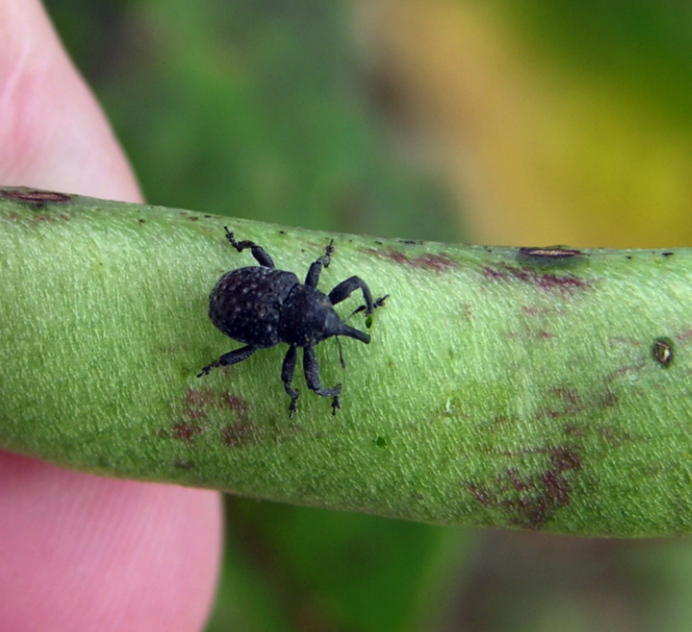
Seasonal Distribution: There are 3-4 generations of the tobacco flea beetles per year. High numbers have been observed in South Georgia in late June in solanaceous crop transplants, and we think that this is likely a second generation. Only up to two generations of pale striped flea beetle have been reported per year.
Damage

Typical flea beetle damage occurs in the foliage of young crop plants, and damage usually manifests itself as numerous small shot holes through the leaves. This occurs early in the growing season and can show up soon after transplanting depending on the date.
Management
Significant yield loss has been reported for levels of flea beetles at
five adults per plant very early in the growing season. We suspect that
5-10% defoliation is sufficient reason for controlling this foliar feeder
early in the growing season. Middle to late season control is seldom if
ever warranted. Natural enemies of the tobacco flea beetle adults
include the bigeyed bug, Geocoris punctipes.