Xylocopa virginica [L.])
Authors: A. J. Stevenson, D.R. Suiter, B.T. Forschler, University of Georgia
Appearance
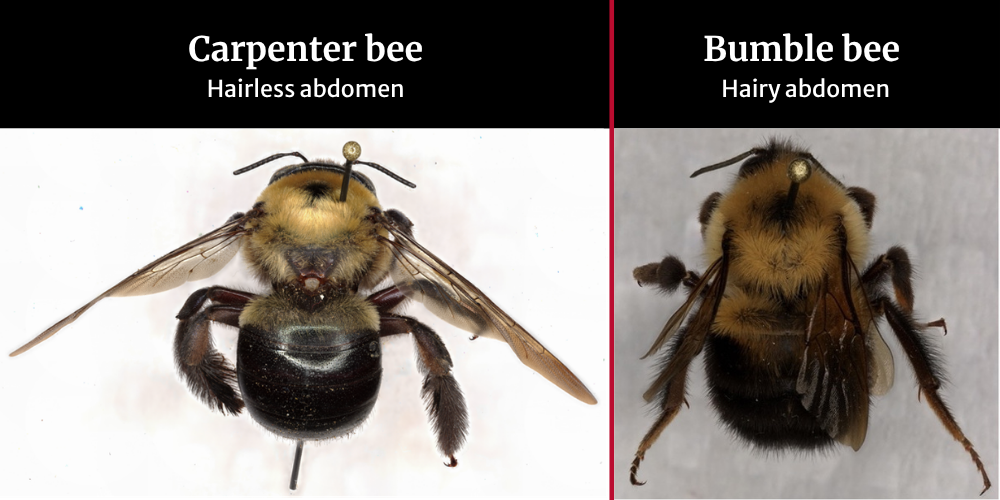
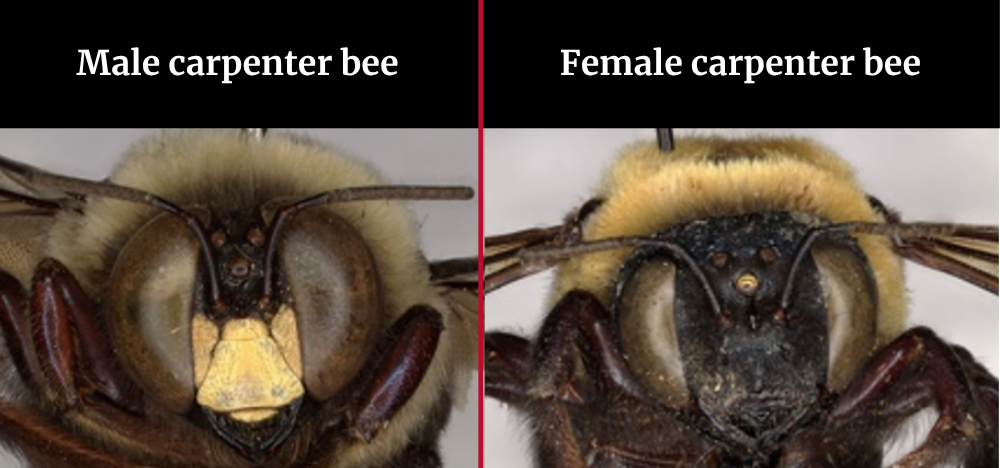
A large bee (¾ -1 inch in length) similar in size to a bumble bee (Figure 1). They possess a yellow, fuzzed thorax and a metallic black abdomen that is smooth and lacks hair. Females possess an all-black head and large mandibles, while males are identifiable by a smaller set of mandibles and a light, yellowish-white patch on the center of the face, as seen in the Figure 2.
Range
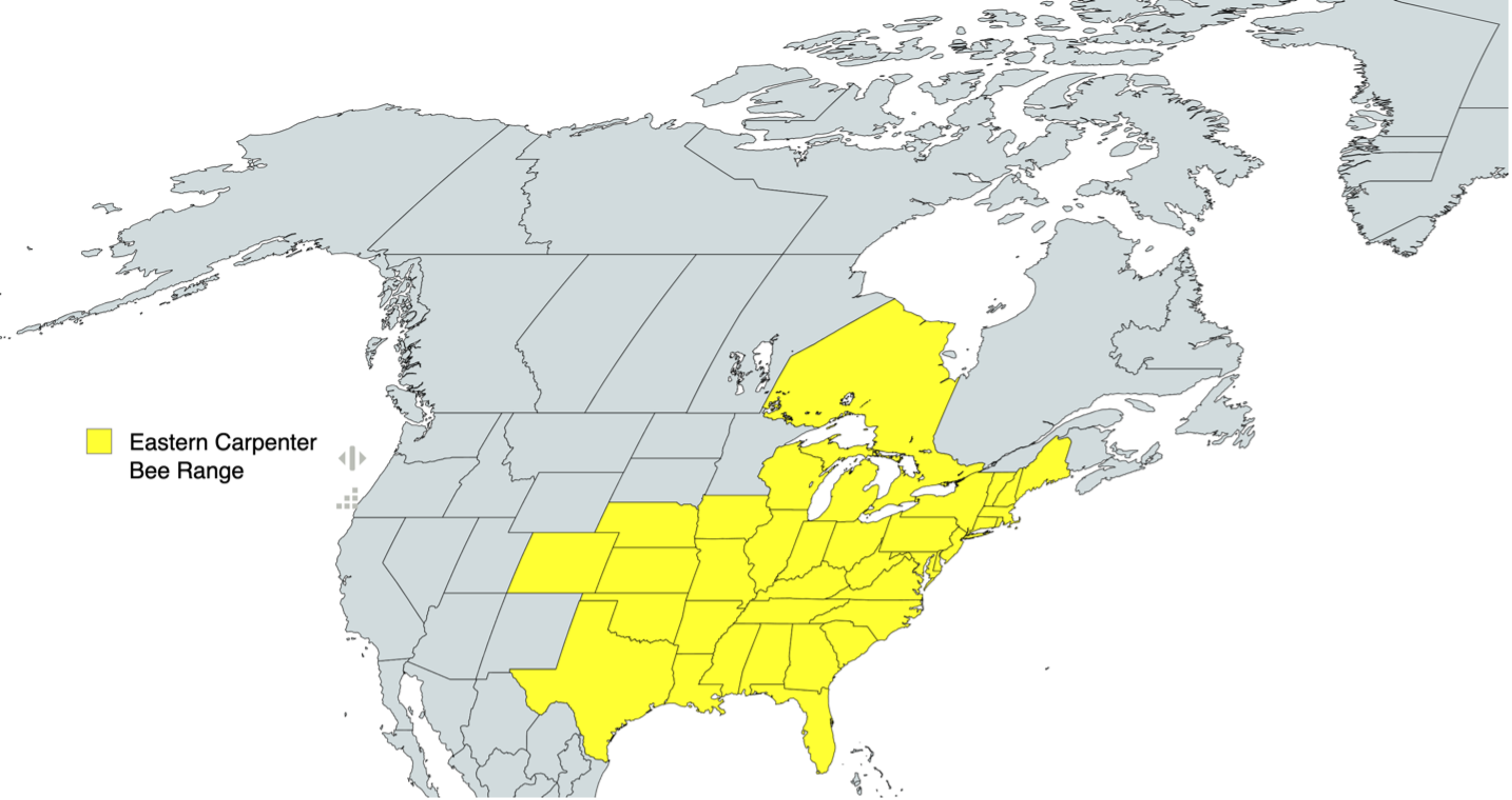
The eastern carpenterbee is native to eastern North America and ranges from southern Canada to Florida and from the Rocky Mountains to the Atlantic Coast (Figure 3)(Skandalis et al. 2009). In southern Georgia, their range overlaps with the southern carpenter bee, Xylocopa micans, which is smaller and typically nests in natural woody plant material.
Nests

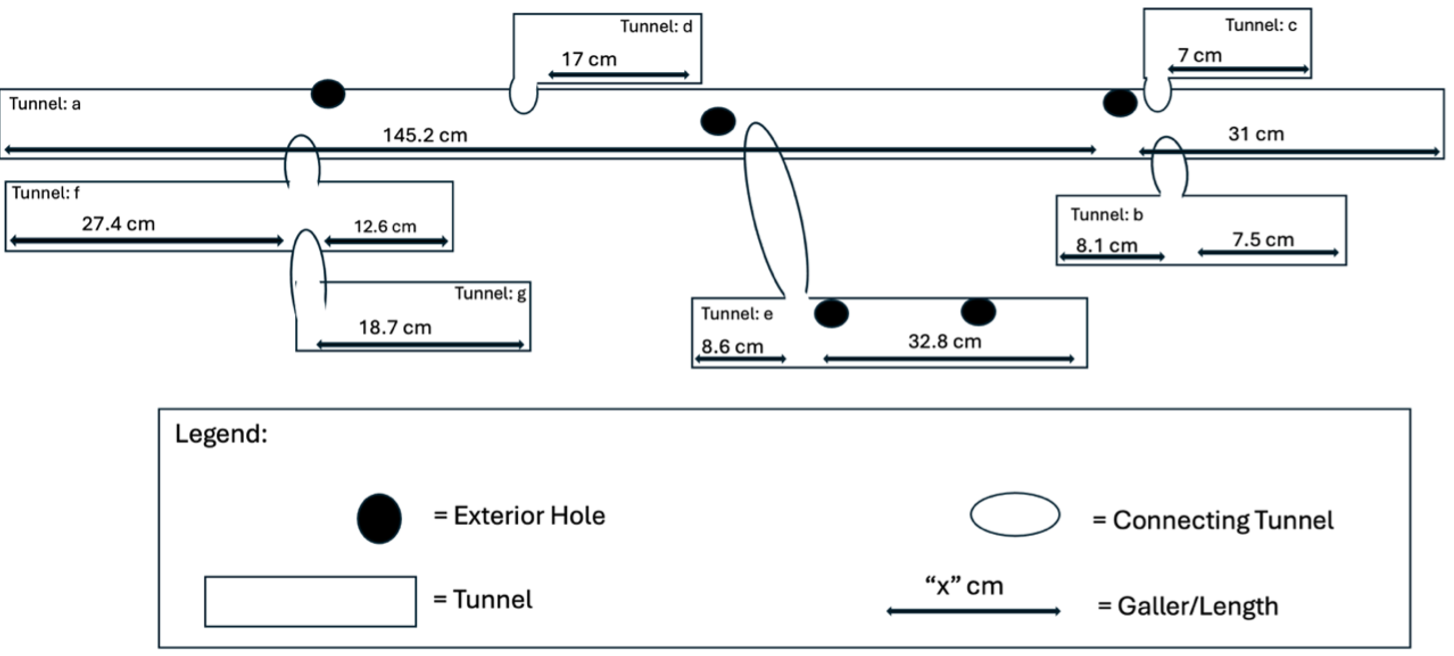
Female carpenter bees can, with their large mandibles, excavate nests in structural lumber where they rear the next generation of bees (Figure 4). The presence of a nest can be identified by the circular entrance hole roughly 0.8 inches in diameter on the surface a piece of lumber positioned to discourage entry of water – usually facing the ground (bottom of the board). An entrance hole leads to galleries inside the lumber termed a nest where the bees reside and rear their young. Nest architecture varies along a continuum from a single gallery spanning a few inches to multiple holes leading to a series of interconnected galleries representing a single nest (Figure 5). Female bees excavate new or expand old nests after mating in the spring and the resulting ‘sawdust’ expelled from the hole is a sign of an active carpenter bee infestation. The size and complexity of nests increases each year after initial nest establishment. A recent study of seven boards removed from a decade-old bench showed the highest proportion of wood removed from a single board was 18% over a ten-year period (Stevenson, Personal Observation). That board, a 7 ft. long 2X4, had 15 holes associated with 28 galleries (2-21 inches in length) organized into 13 nests with 12 single hole nests and one, 3-hole, multiple hole nest for a total length of excavated galleries of 28 feet (Stevenson, Personal Observation).
Seasonality & Social Structure
Carpenter bee adults are often first noticed in early spring when males leave nests to establish and guard a mating territory by flying aggressively to ward off intruders. Although aggressively territorial, male carpenter bees are harmless because they lack a stinger. They are also short lived, usually dying by early summer, soon after mating. Spring-mated females excavate galleries by establishing new nests within wood or extending galleries within established nests and construct chambers, or brood cells, separated with walls of chewed wood pulp (Gerling and Hermann 1978). The brood cells contain an egg and are provisioned with a ball of pollen as food for the growing larva. Females can live for several years, and although often considered a solitary species, multiple females may occupy the same nest throughout the year. In nests with more than one female, only one lays eggs while the others assist in expanding and protecting the nest. A new generation of bees develop by late summer after which they emerge from the nest to feed on nectar and pollen in preparation for overwintering. Once the temperature drops, they enter diapause, a hibernation-like state, and pass the colder months within their home nests before emerging again in the early spring to renew the cycle. Carpenter bees lack a hive structure and caste system like the honeybee and are thus considered semi-social bees. A single family, the original mother and her daughters, may occupy the same nest for years, while other daughters leave the original home nest to start additional nests (Richards, 2011; Gerling, 1978; Somanathan, 2019 ).
Ecosystem Engineers
Carpenter bees are native to North America and play a role in pollinating plants. We examined 23 X. virginica nests containing brood cells and estimated the bees collected 8.6 billion pollen grains during 7,150 foraging trips between May and June (Tucker et al. 2019). Carpenter bees are known to engage in a behavior known as “nectar robbing”, where they will access nectar through a slit cut in the side of the flower rather than enter through the main opening (Dedej and Delaplane 2004, Sampson et al. 2004). Despite that behavior carpenter bees collect a considerable amount of pollen for brood care and are considered valuable pollinators (Cane et al. 1985, Tucker et al. 2019, Somanathan 2019). Additionally, carpenter bees may also play an important role in supporting other arthropod diversity by providing nest and harborage sites.
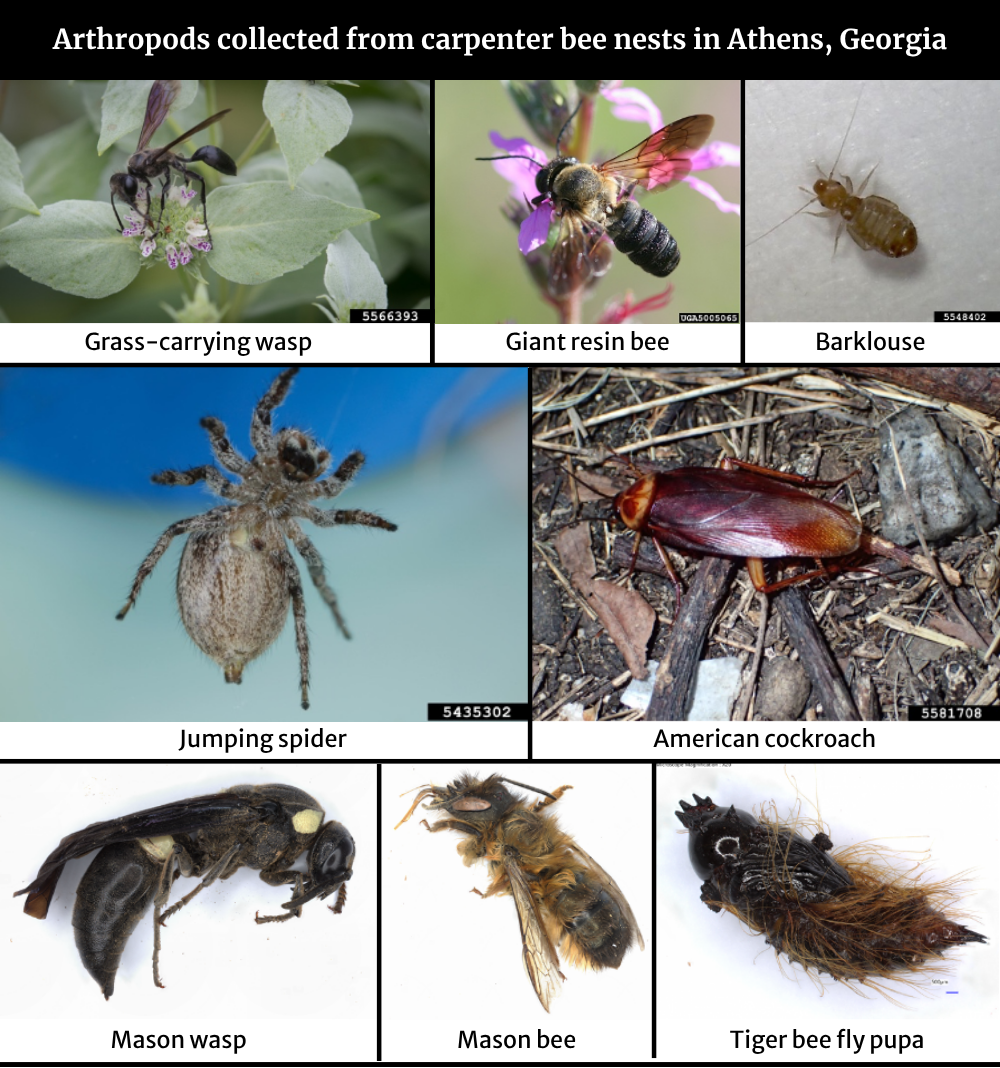
Carpenter bee females have strong mandibles and are one of few insects that can excavate dead wood to form nests. Their nest construction behaviors create new habitat for other insects in urban/suburban landscapes. Several species of wasps and bees may utilize carpenter bee galleries for their own nesting activities. We collected over 50 other insects or brood representing mason bees, resin bees, mason wasps, grass-carrying wasps, and 8 other arthropod species from 45 carpenter bee-constructed nests (Figure 6). Those nests included 25 occupied by X. virginica that contained 44 carpenter bee adults and 145 brood (Stevenson personal communication).
The ability of carpenter bees to construct nesting and refuge sites for other arthropods in anthropogenic habitats highlights their role as a facilitator of biodiversity. These bees have the potential to transform any backyard into suitable habitat for themselves, additional pollinators, as well as other arthropods, including predators and prey.
Intervention
Persistent spring-time presence of male carpenter bees displaying aggressive territorial behavior is an obvious sign of nearby nests. While the structural damage caused by carpenter bees is usually minimal in the short term, over time, nests can prove attractive to one of their natural enemies – woodpeckers. Woodpeckers excavate carpenter bee nests creating unsightly holes in the face grain of a board as they expose galleries to eat the insect contents within. There is no way to discourage woodpeckers from searching for food or the subsequent damage to lumber resulting from their pecking behavior to find carpenter bees. Unfortunately, carpenter bee nests in a piece of lumber will always be attractive to woodpeckers that may locate and try to eat them. Thus, prevention of carpenter bee activity in structural lumber is the primary, proactive intervention and involves coating all exposed wood with paint or varnish. Application of pesticides to the exterior surface of structural lumber is not effective and as such, is not recommended for exterminating or preventing carpenter bee nests. The cryptic nature of their nests complicates successful efforts to eradicate carpenter bees and the best results therefore involve labor-intensive control recommendations. Locating nest entry holes does provide options including application of a registered residual pesticide… but only into the hole. Another option would be to plug the nest entry hole with material the bees cannot chew such as stainless steel or copper mesh. There have been no objective, peer-reviewed evaluations of the efficacy of repellents or the ability of carpenter bee traps for managing infestations. Although it might be satisfying to see the number of bees killed by trapping, remember that an established nest can produce 1-20 bees each year. Therefore, infestation prevention continues to be the most effective option for managing these often misunderstood, yet important, animals in structural lumber.
References
Cane, J. H., Eickwort, G. C., Wesley, F. R., & Spielholz, J. (1985). Pollination ecology of Vaccinium stamineum (Ericaceae: Vaccinioideae). American Journal of Botany, 72(1), 135–142. https://doi.org/10.1002/j.1537-2197.1985.tb08350.x
Dedej, S., & Delaplane, K. S. (2004). Nectar-robbing carpenter bees reduce seed-setting capability of honey bees (Hymenoptera: Apidae) in rabbiteye blueberry, Vaccinium ashei, ‘Climax’. Environmental Entomology, 33(1), 100–106. https://doi.org/10.1603/0046-225X-33.1.100
Gerling, D., & Hermann, H. R. (1978). Biology and mating behavior of Xylocopa virginica L. (Hymenoptera: Anthophoridae). Behavioral Ecology and Sociobiology, 3(1), 99–111. https://doi.org/10.1007/BF00258458
Richards, M. H. (2011). Colony social organisation and alternative social strategies in the eastern carpenter bee, Xylocopa virginica. Journal of Insect Behavior, 24(5), 399–411. https://doi.org/10.1007/s10905-011-9261-7
Sampson, B. J., Danka, R. G., & Stringer, S. J. (2004). Nectar robbery by bees Xylocopa virginica and Apis mellifera contributes to the pollination of rabbiteye blueberry. Journal of Economic Entomology, 1 97(3), 735-740. https://doi.org/10.1093/jee/97.3.735
Skandalis, D. A., Tattersall, G. J., Prager, S. M., & Richards, M. H. (2009). Body size and shape of the large carpenter bee, Xylocopa virginica (L.) (Hymenoptera: Apidae). Journal of the Kansas Entomological Society, 82(1), 30-42. 1 https://doi.org/10.2317/JKES711.05.1
Somanathan, H., Saryan, P., & Balamurali, G. S. (2019). Foraging strategies and physiological adaptations in large carpenter bees. Journal of Comparative Physiology 1 A, 205(3), 387-398. https://doi.org/10.1007/s00359-019-01323-7
*Figure 6 photo credits:
a. Grass carrying wasp – David Cappaert, Bugwood.org
b. Giant resin bee – David Cappaert, Bugwood.org
c. Barklice – Mohammed El Damir, Bugwood.org
d. Jumping spider – Joseph Berger, Bugwood.org
e. American Cockroach – Whitney Cranshaw, Colorado State University, Bugwood.org
f-h. Mason wasp, Mason bee, Tiger bee fly pupa, left to right – AJ Stevenson