Phillip M. Brannen, University of Georgia Department of Plant Pathology & Sarah Lowder, University of Georgia Horticulture Department
Mancozeb has long been a crucial fungicide for grape production in Georgia and across the southeastern United States. Its broad-spectrum efficacy, low risk of resistance development in fungal pathogens, and consistent performance against various diseases have made it especially valuable early in the season. However, mancozeb faces increasing regulatory pressure both in the U.S. and globally. The U.S. Environmental Protection Agency (EPA) has proposed banning the use of mancozeb in grape production, citing concerns over post-application health hazards for workers performing tasks such as leaf-pulling and hand-harvesting. While other fruit crops may retain access through restricted reentry intervals, the EPA notes that the lengthy restrictions necessary for grapes would be too disruptive for typical vineyard management. This potential ban would force growers to switch to more expensive, single-site fungicides, increasing production expenses and the risk of pathogen resistance to these fungicide classes. If the EPA removes the tolerance for mancozeb on grapes, growers will need to reevaluate their early-season disease control strategies.
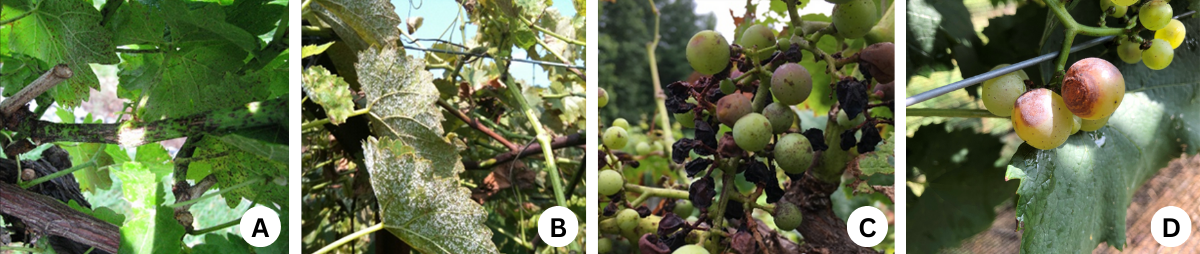
Mancozeb is widely used for early-season management of several key pathogens, including Phomopsis cane and leaf spot (Phomopsis viticola), downy mildew (Plasmopara viticola), black rot (Phyllosticta spp.), and ripe rot (Colletotrichum spp.) (Fig. 1). To better understand alternatives to mancozeb and their efficacy against two of these diseases, black rot and downy mildew, a 2025 field trial at the University of Georgia tested three products as potential replacements. These included Captan 4L at the label’s lowest rate (to maximize the number of applications), Kocide 3000 at the highest labeled rate (to boost copper efficacy, which is generally lower than mancozeb), and Howler Evo at the highest labeled rate (a biological fungicide containing formulated Pseudomonas chlororaphis). Manzate Prostick (mancozeb) was applied at a rate typical for Georgia wine grape vineyard management. The study was conducted in a ‘Camminare Noir’ vineyard block at the University of Georgia Durham Horticulture Farm in Watkinsville, Georgia, with vineyard practices consistent with commercial production. All treatments were applied five times from mid-April to the end of May. Since sulfur is essential for managing powdery mildew but has limited activity against black rot and downy mildew, all treatments included sulfur (Microthiol Disperss). A sulfur-only treatment served as the untreated control. The 2025 trial experienced high disease pressure, with 25 days of rainfall averaging 0.2 inches per event, coupled with an average temperature of 69°F. These conditions are ideal for rapid development of black rot and downy mildew, and high-pressure environments are critical for testing fungicide efficacy.
Black rot incidence was near 100% across all treatment groups, leading us to focus on fruit black rot severity (the percentage of the grape cluster area covered by the disease) (Table 1). Mancozeb (Manzate Prostick)achieved the lowest disease severity at 13.3%, while Captan 4L resulted in 23.8% severity. While numerically higher than mancozeb, this was statistically equivalent to the mancozeb treatment, representing a significant reduction compared to the control. Kocide 3000 showed a severity of 33.0%; while it provided “substantive control” compared to the untreated control (58.7%), it was not statistically equivalent to mancozeb. Howler Evofailed to provide efficacy, resulting in 57.5% severity, which was statistically identical to the untreated sulfur control.
Efficacy against downy mildew was measured through three metrics: leaf incidence, leaf severity, and a whole-plant visual rating. For leaf disease incidence and severity, Manzate Prostick remained the most effectivefungicide, reducing leaf incidence to 65.0%. Captan 4L followed closely at 77.7%, which was again statistically equivalent to mancozeb. Kocide 3000 (85.7%) was less effective in preventing disease incidence. However, when measuring leaf severity (percentage of leaf area covered with diseased tissue), mancozeb (4.6%), captan (5.0%), and copper (5.3%) all performed similarly and were significantly better than the control (16.6%). For whole plant severity, incorporating total plant damage and defoliation, the rankings were similar, with mancozeb at 10.2% damage, captan at 16.7% damage (statistically equivalent to mancozeb), Kocide 3000 at 25.8% damage (also statistically equivalent to both mancozeb and captan), and Howler Evo showing 72.3% damage (basically equivalent to the untreated control of 68.8%).
Captan 4L, a representative of captan products in general, was the most viable candidate for replacement of mancozeb based solely on this trial. It was surprising that the low rate of Captan 4L performed as well as it did. By using the lowest labeled rate, growers could potentially increase the number of applications per season to achieve broad-spectrum coverage against several key diseases throughout most of the season. Despite the low rate, its ability to remain statistically equivalent to mancozeb in controlling both black rot and downy mildew suggests it could serve as a primary replacement. When combined with phosphonate fungicides like Prophyt and single-site fungicides (those that retain efficacy where fungal resistance is not prevalent), captan might become an even more important tool for future spray programs.
Kocide 3000 (copper) remains a useful broad-spectrum fungicide, especially for downy mildew management. However, its inability to match mancozeb’s effectiveness against black rot raises questions about its suitability as a standalone replacement. Furthermore, environmental concerns about copper buildup and the risk of phytotoxicity (plant tissue damage) limit its widespread use. Although no significant phytotoxicity was seen in this trial, warmer weather could increase this risk, and damage might be more common on certain cultivars or hybrids than others.
Howler Evo demonstrated the limitations of biological fungicides. Although Howler Evo has been reported to have efficacy in some trials, the inconsistency in control is likely due to varying environments and disease pressures. In this study, Howler Evo did not show efficacy against either pathogen. Its performance was consistently similar to the untreated control across all metrics.
This trial showed that although mancozeb remains the preferred product, a mix of captan, copper, and other fungicides could potentially replace it if regulatory policies change. This study provides several important insights for future disease management, but any conclusions will need further validation through additional trials. There are some promising results to consider: applying captan throughout the season at lower rates may offer the extended coverage needed if mancozeb is no longer used. Copper can likely be included in spray programs but should be monitored for phytotoxicity during hot conditions and when applied to both Vinifera and hybrid grapes. Note that this trial did not evaluate effectiveness against Phomopsis or ripe rot, which mancozeb also controls. As mentioned, more testing is necessary to confirm these findings across different grapevine varieties and in various weather conditions in Georgia and beyond.
To reiterate, captan seems to be the most viable mancozeb alternative currently available for early-season disease management in grapes. Copper may play a supplementary role, while biological products should not be relied upon for primary disease control unless they have been thoroughly vetted and proven to be consistently efficacious. Growers should stay informed of E.P.A. updates while possibly beginning to trial these alternative chemistries in their own integrated pest management (IPM) programs.
| Treatment and amount/A | Application timing x | Fruit black rot severity (%)y | Downy mildew: Leaf incidence (%)z | Downy mildew: Leaf severity (%)z | Downy mildew: Whole plant severity (%)z |
|---|---|---|---|---|---|
| Microthiol Disperss 3 lb | ABCDE | 58.7 a | 99.0 a | 16.6 a | 68.8 a |
| Microthiol Disperss 3lb + Manzate Prostick 3 lb | ABCDE | 13.3 c | 65.0 c | 4.6 b | 10.2 b |
| Microthiol Disperss 3lb + Captan 4L 0.75 qt | ABCDE | 23.8 bc | 77.7 bc | 5.0 b | 16.7 b |
| Microthiol Disperss 3lb + Kocide 3000 1.75 lb | ABCDE | 33.0 b | 85.7 ab | 5.3 b | 25.8 b |
| Microthiol Disperss 3lb + Howler Evo 7.5 lb | ABCDE | 57.5 a | 97.3 a | 17.4 a | 72.3 a |
| LSD (α = 0.05) | 17.7 | 14.4 | 4.6 | 18.1 |
Treatment dates: A = 13 Apr, B = 26 Apr, C = 8 May, D = 19 May, E = 31 May.
yFruit black rot severity (% of cluster area covered by black rot) was calculated from 10 representative grape clusters per plant. Means followed by the same letter are not significantly different when comparing each pair using a Fisher’s protected LSD test of significance (P≤0.05).
zDowny mildew incidence (% of leaves with downy mildew) and severity (% of leaf area covered by downy mildew) was calculated from 50 leaves per plant. Whole plant severity is a subjective visual rating that incorporates total plant damage from downy mildew, to include defoliation. Means followed by the same letter are not significantly different when comparing each pair using a Fisher’s protected LSD test of significance (P≤0.05).